Physical Address
304 North Cardinal St.
Dorchester Center, MA 02124
Physical Address
304 North Cardinal St.
Dorchester Center, MA 02124

Why we need to stop trying to be seamless
There is a sitar in my flat that I have not played in a while. The string broke a couple of months ago and I told myself I would replace it the following weekend. I didn’t. And now it sits there like an accusation, beautiful and incomplete, and every time I pass it I feel a small, familiar shame: the shame of a thing left unfinished, of a gap I haven’t had the courage to close.
I grew up in a mountainous region in northern Pakistan under the foothills of Himalayas. The mountains are gigantic that have been cracked open by glaciers and knit back together by time. Nothing up there is smooth. The valleys are made of fracture lines. The rivers run through wounds in the earth. And yet those fissures are where everything beautiful has settled. The flowers grow in the cracks. The villages cling to the broken ridges. The water sings loudest where the rock has split.
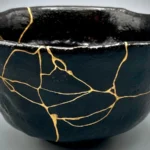
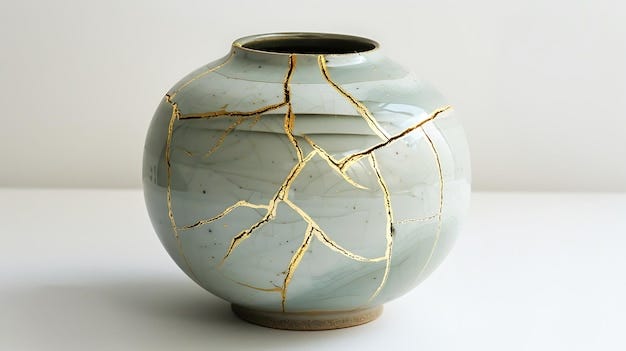
I didn’t have a word for this idea until I came across kintsugi (金継ぎ) — the Japanese art of repairing broken pottery with gold. Not hiding the damage. Not throwing the broken piece away. But mending it with a lacquer mixed with gold powder, so that the fracture becomes, quite literally, the most luminous part of the object.
The word itself: kin means gold. tsugi means joinery, or continuation. Golden joinery. A repair that does not apologise for itself.
What we do with the broken things? My instinct (and I suspect this is not unique to me, but it runs especially deep in the culture I come from) is to everything I can to hide the damage. To present a seamless version. To fix things quietly, in private, and then reappear as though nothing happened. In desi households, you don’t talk about what broke. You get on. You manage. You perform wholeness so convincingly that eventually you half-believe it yourself.
But this is not resilience. It is cosmetic repair. The crack is still there; you’ve just painted over it.
Kintsugi refuses that logic entirely. The Japanese philosophy it belongs to, wabi-sabi, holds that nothing is permanent, nothing is perfect, nothing is finished. Breakage is not an interruption to the life of an object; it is part of its biography. A bowl that has been dropped and repaired is not a lesser bowl. It is a bowl with a history. And the repair is the proof that someone found it worth saving.
“The crack is not the end of the story.
It is often where the story begins to get interesting.”
I have been in therapy for about a year now, doing the slow, uncomfortable work of understanding my own attachment patterns. The ways I go distant when things get hard, the ways I turn ambivalence into inaction, the ways I can look at something important and find every reason not to commit to it. It has not been a glamorous process. There is no moment where everything suddenly becomes whole. There is just, gradually, more honesty about where the cracks are. And then, sometimes, a tentative decision about what to do with them.
The Buddhist roots of kintsugi speak to this. The practice emerges partly from mushin — a concept of non-attachment, of not clinging — and from mono no aware, the bittersweet awareness of impermanence. Things break. People change. Relationships fracture. The question is never whether this will happen, but what you do in the aftermath.
Kintsugi emerged in Japan in the late 15th century, attributed to the Shogun Ashikaga Yoshimasa, who sent a broken Chinese tea bowl to China for repair. It came back held together by ugly metal staples. Dissatisfied, he commissioned Japanese craftsmen to find a better way. What they came up with was not just a technique but a philosophy: make the repair visible, make it beautiful, and in doing so, honour the object’s full life rather than pretending part of it didn’t happen.
The method is painstaking. Urushi lacquer — derived from the sap of the urushi tree — is mixed with powdered gold and applied to the fracture, then polished. It takes weeks. The repair costs more than the original bowl was worth. This is, on the face of it, irrational. But that’s rather the point. The expenditure of effort on something broken is itself a statement of value. You are saying: this thing, in its damaged state, is still worth my time and gold.
There is a version of this I find in my academic work too. Learning analytics, which sits at the centre of my PhD research, is fundamentally about tracking where people struggle — not to penalise them for it, but to understand and intervene. The data trail of a struggling learner is not a record of failure. It is a map of where the cracks are. And if the system is well-designed, those cracks become exactly where the learning happens. The educational literature calls this “productive failure.” I call it kintsugi thinking.
Here is the part nobody tells you: the repair is not passive. Gold does not pour itself into the crack. Someone has to decide to do it.
I have spent a lot of my adult life in the space between recognising that something is broken and deciding to repair it. The gap is not intellectual — I can name the cracks clearly enough. It is volitional. The step from knowing to doing, from insight to action, is where I tend to stall. And the longer I wait, the more the broken thing becomes the normal state of things, and I start to build my life around the gap rather than filling it.
The sitar string. The unfinished essay. The conversation I keep meaning to have but haven’t.
Kintsugi asks something harder than I initially gave it credit for. It doesn’t just invite you to accept your brokenness. It asks you to actively transform it — to bring deliberate effort, real material, real time — and make the repair visible and proud. That requires a kind of self-respect that isn’t always easy to locate.
“You are not a bowl that is better left
hidden in the back of the cupboard.
You are a bowl that can hold water again.”
Ithink about the mountains in Gilgit often when I think about this. They were not beautiful despite the cracks. They were beautiful because of them — because of the millennia of breakage and settling, of glacial force and tectonic patience, of water finding its way through stone. What I grew up thinking of as harshness was actually a kind of extravagant history. Every cliff face a record. Every valley a healed wound.
I didn’t need to come to London to learn this. I had the lesson in front of me the whole time. I just needed a Japanese word for it.